
Civic Activities:
– For a Democratic Europe
– For Civil and Political Rights in Burma
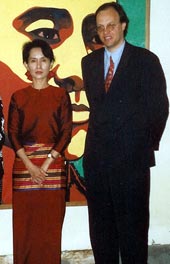
Photo: With one of my hero,
Aung San Suu Kyi,
in her home in Rangoon,
1996(Burma)
For a Democratic Europe
- Helmut Schmidt
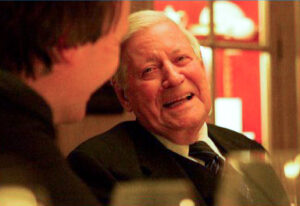
I shall miss Helmut Schmidt. He has inspired me ever since I met him in 1969 as young high school student. In 2010, he allowed me to organize a diner for him with some leading Europeans. Here is a transcript of the fascinating discussion : A Dinner with Helmut Schmidt (See pictures here)
- Europe’s democratic momentThe election of a new President of the European Commission is a historic step forward in the process of democratization of policy making in the European Union. Here is why I believe the European Parliament should be in charge.
- Juncker is the democratic choice to head the EU commission in: The Guardian, 6 June 2014.
- European elections – Academics support Juncker in: Luxemburger Wort, 7 June, 2014
- Professoren fordern Juncker als Kommissionschef in: Die Welt, 06 Jun. 2014.
- L’APPELLO – Il presidente della Commissione sia quello indicato dal voto europeo in: Corriere della Sera, 6 giugno 2014.
- Test démocratique pour l’Europe : les citoyens ont leur mot à dire – Des intellectuels appellent le Conseil européen à prendre en compte le résultat des dernières élections européennes pour le choix du Président de la commission. in: Libération, 6 juin 2014.
- Citoyens unis d’Europe – Solidarité et démocratie, 7 juin 2014.
- Rede in Wien
Im Rahmen des SPÖ-Zukunftsprojekts “Österreich 2020” (Ö2020) lud am 14. März 2010 Sozialminister Rudolf Hundstorfer zu einer Diskussion mit dem Thema “Sozialstaat im 21. Jahrhundert – Vision oder Utopie?” ins Parlament. Hundstorfer ist politischer Verantwortlicher der “Österreich 2020″-Diskursgruppe „Soziales, Beschäftigung und Wirtschaft”.
Hier ist die Präsentation in PDF. - Radio interviews:
- France Culture, Emission “A suivre” du 01/02/2009
- « Pour un oui ou pour un non »: débat entre Stefan Colignon et Arnaud Montebourg sur le traité européen lors de l’émission « la suite dans les idées » du 18 mai 2005, sur France culture.
enregistrement de l’emission en format mp3 ici. (59:56 mn – 41,2 Mo)
- Since 1969: Member of German Social Democratic Party (SPD)
- Since 1990: President of Association France-Birmanie.
- 1993-1995: European Coordinator of European Burma Support Groups.
COURSE ON MYANMAR ECONOMY
I’ve been teaching Political economy courses to some burmese students. Here is the powerpoint :
The Myanmar economy after the February 2021 Coup
PAPERS
- Human Rights and the Economy in Burma; in: Robert Taylor, Burma, Political Economy under Military Rule, C. Hurst & Co, London, 2001.
- Why Do Poor Countries Choose Low Human Rights? Some Lessons from Burma; Habilitationsvortrag, Freie Universität Berlin, 1999. Sumary and download
- The Burmese Economy and the Withdrawal of European Trade Preferences; in: EIAS Briefing Paper No. 97/02, Brussels, April 1997.
Download in PDF.
On the subject I also find interesting the following work:
- Priscilla Clapp : Building Democracy in Burma, United States Institue of Peace Working Paper, 2007. (Download in PDF)
- David Arnott, La destruction de l’économie birmane par les militaires. In : Relations internationales et stratégiques, n” 27, automne 1997, pp 129-141. (Téléchargement en PDF)
The Political Economy of Military Rule in Myanmar
This paper focuses on Myanmar, where the military has ruled for over 60 years. It gives a historic overview of regime changes under military rule and explains the role of the Tatmadaw (the military) as the guarantor of a hierarchical Buddhist system, which has excluded ethnic minorities. It then formulates a theoretical conflict model with three poles: the two contestants are the Tatmadaw and the Ethnic Armed Organisations (EAOs) who seek to control the government, but the government contributes to economic growth but not to civil war. The military wishes to keep its sovereign status, the EAOs seek to reduce the poverty gap which affects their regions most. To achieve these objectives, they require resources, which they acquire directly by appropriating natural resources and indirectly by transfers from government. Controlling the government can shift the balance of resources in favour of either of the two contestants. A general equilibrium in the balance of power depends on military efficiency and the poverty gap.